Personal Growth
Run Your Own Race: How Comparison Quietly Drains Our Money, Confidence and Peace
Open LinkedIn on any given day and you will see it. Someone got promoted. Someone earned a new certification. Someone is speaking on a panel, or joining a roundtable with people you admire. The congratulations pour in, and somewhere in the back of your mind, a small voice asks: am I falling behind?
If you have felt that, you are not alone. I have felt it too. And it is not only LinkedIn. It is Instagram, family gatherings, group chats, and sometimes just the next desk in the office.
So let me start with a small picture.
Picture this. You and a colleague line up for a 400-meter race. Same track, same finish line. But there is a catch: your colleague starts 100 to 150 meters ahead of you. The gun fires. You push hard, and at 200 meters you are still behind.
If you keep running, who wins?
Not you. And not because you are slower. The race was never fair.
Most of us run this race every single day without noticing. I did too, for a long time.
Why we compare
Comparison is not a weakness. It is part of being human. In 1954, psychologist Leon Festinger proposed social comparison theory: we judge our abilities and success by looking at other people. It helped our ancestors learn and stay safe in groups, and a little comparison can still inspire us to grow.
The trouble is how we do it. We compare our inside with someone else’s outside. Our doubts against their confidence. Our full story against their final result. And we almost never ask the one question that matters: what was their starting line?
It shows up everywhere. A colleague’s promotion makes your own progress feel like failure. Parents compare their children with cousins and classmates, and those children carry that voice into adulthood. A friend buys a house, and your savings suddenly feel small. We even measure ourselves against timelines nobody agreed to: married, settled, with children by a certain age.
Social media turned the volume up
Earlier, we compared ourselves with a few dozen people nearby. Now we compare ourselves with thousands of people, all day, in our pockets.
On Instagram, it is the holidays and the photos. On LinkedIn, it is the promotions, the certificates, the stage and the applause. Different platform, same effect.
What we see is a highlight reel: the best moments, carefully selected, neatly edited, and sometimes not even real. Nobody posts the rejection emails, the failed interviews or the nights of doubt. Yet our brain reads it as everyone else’s normal life. So we walk away feeling that we are late, slow, or missing out.
My starting line
I felt this personally the day I joined engineering college. I came from a rural background. I had barely used a computer, and my communication skills were far from good. When I looked around, everyone else seemed more confident, more capable, already ahead before the race had even begun.
So, to catch up, I worked hard. Semester after semester, I kept pushing myself. Slowly, things started to change. I became one of the top students in my class. For a while, I truly believed I had caught up. I thought I was finally ready to win the race.
Then came the seventh semester, and placement season began. Companies started coming to campus, one after another.
I still remember my very first placement interview. A leading company came to recruit, and I cleared every technical round. Then came the HR interview. I was nervous. My hands were shaking.
The interviewer handed me a small water bottle and, before even asking my name, he said, “Speak about this water bottle for a minute.”
I froze. I could not make a single sentence.
It was the first time in my life that I had been asked to simply speak, on the spot, with nothing prepared and nothing memorized, and that too in English. And I failed.
It was not the only time. Interview after interview, I cleared the technical rounds but stumbled the moment I had to speak confidently. Meanwhile, my friends, the same people I had prepared with, started getting placed one by one while I was still waiting.
It was not just difficult. It was humbling.
But I had a choice. I could keep measuring myself against everyone around me and feel discouraged every time someone moved ahead. Or I could stop and ask myself: why? Why did I need to compete with them at all?
Everyone was running their own race, and each of them was exactly where they were meant to be, in their own journey, at their own pace. My race was mine alone. Instead of looking at how far ahead others were, I needed to look at how far I had already come, and put my effort in the right direction.
So, I kept going, for almost another year. I practiced speaking every single day. I forced myself into conversations I would once have avoided. I failed more interviews. I got up, and tried again. And slowly, the same water bottle that once left me speechless became something I could talk about for minutes without fear.
Eventually, I landed a strong job, one of the better ones in my batch.
I did not win by catching up with them. I won because I finally stopped running their race, and started running mine.
What comparison quietly makes us do
Comparison does not stay in our heads. It changes what we do.
We chase what others are chasing. The next title, the next certificate, the next big announcement, not because it fits our path, but because it fits someone else’s post.
We spend to keep up. The latest phone, a bigger car, branded clothes, an expensive holiday. Many purchases are not about need. They are about not being the one left behind.
We reshape ourselves. Filters and influencer standards have made many people unhappy with their own faces and bodies. Wanting to look after yourself is healthy. Changing yourself to match a screen is not.
We decide for the wrong reasons. Careers, marriages, cities, even the timing of having children can be driven by what everyone else is doing.
We lose our peace. Constant comparison feeds anxiety, jealousy and burnout. Even people who seem to be winning feel they are not enough, because someone is always further ahead.
A quiet cost: when comparison goes on credit
Easy monthly installments make this pattern even easier. When everything can be split into small EMIs, we stop asking, “What does it cost?” and start asking, “What is the monthly amount?” Small payments stack up quietly, and they borrow from income we have not earned yet.
This is not an argument against all borrowing. A home loan or an education loan can be a sensible, planned choice. The question is the motive. Before you click “Buy on EMI,” ask yourself: do I need this, or am I trying to keep up? If it is the second, you are not buying a product. You are buying a place in someone else’s race.
How to run your own race
These are the habits that helped me. None of them are complicated.
- Ask about starting lines. Before comparing, ask what theirs was and what yours is.
- Remember it is a highlight reel. Nobody posts their debts, failures or bad days.
- Celebrate people without measuring yourself. When a colleague gets promoted, congratulate them and mean it. Their win takes nothing away from you.
- Pause before you buy. Ask, “Do I want this, or do I just want to keep up?” For big purchases, wait 48 hours.
- Clean up your feed. Mute accounts that leave you feeling smaller. Follow people who teach, not just display.
- Track your own progress. Write down where you were a year ago and what you have learned since.
- Define your own “enough.” Decide what success means for your life, not for a feed.
And when comparison does help, as inspiration rather than judgment, use it that way. Let someone’s success show you what is possible. Then go back to your own lane.
From the water bottle to the stage
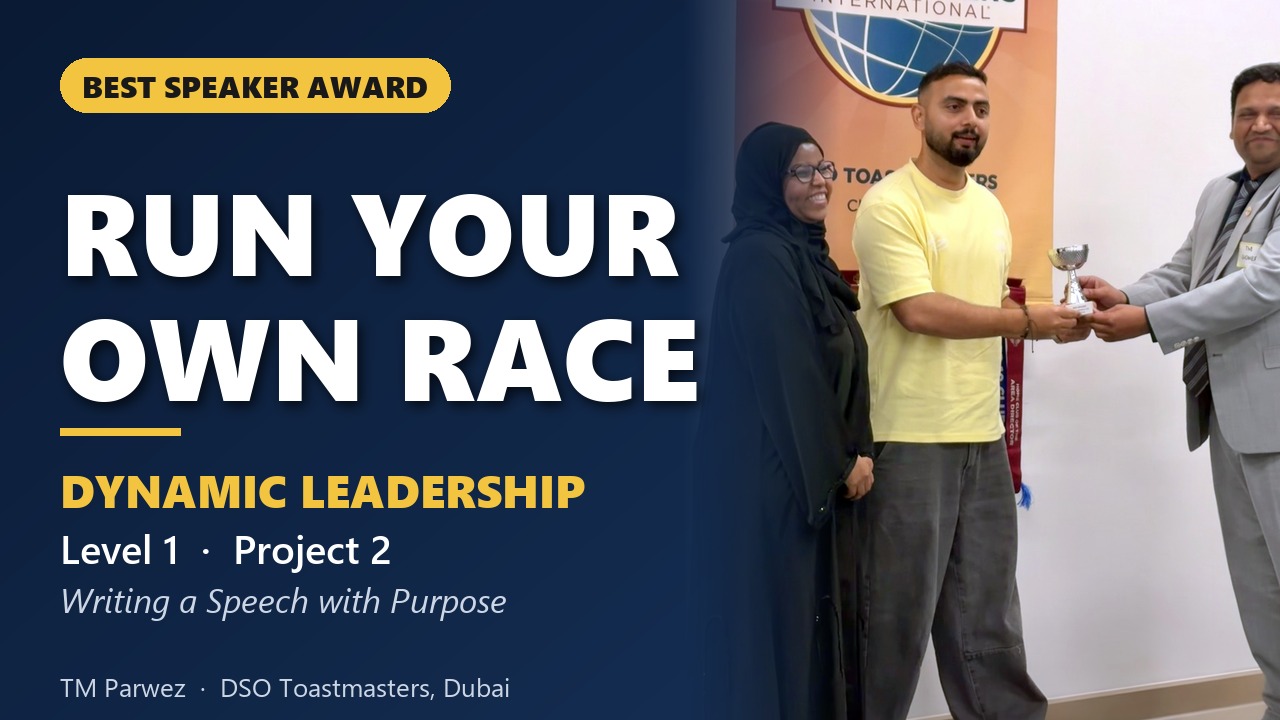
This topic is so personal to me that I chose it for my Toastmasters journey. Speaking was the very thing I once failed at. And there I was, standing in front of an audience, telling the water-bottle story out loud, the one I used to avoid telling anyone.
It was my second speech on the Dynamic Leadership path: Level 1, Project 2, Writing a Speech with Purpose. In my Ice Breaker, I told the story of a boy who froze on a college stage. This project asked for something more: a speech built around one clear purpose. Mine was simple. I wanted everyone in the room to think of the last time someone else’s success made them feel small, and then ask the question I wish I had asked much earlier: what was their starting line?
I delivered it at DSO Toastmasters Club in Dubai on 2 October 2026.
I never expected what came next. That speech won me the Best Speaker award, for the second time in a row after my Ice Breaker.

The trophy is not the part that matters to me. What matters is that the thing I once failed at is now the thing I get to share. I did not catch up with anyone to get there. I just kept running my own race.
Watch on YouTube: Run Your Own Race | Toastmasters Speech - Dynamic Leadership Level 1 Project 2
I would love your honest feedback. Did the opening race make the point? Which moment stayed with you? What would you change in my delivery or message? Leave a comment on YouTube or send me a message. Every bit of feedback helps me grow, and that is what running your own race is about.
Final thought
Someone will always be faster, richer, fitter or further ahead. That race has no finish line. But your own race does, and you can only finish it by looking at your own lane.
So the next time someone’s good news makes you feel behind, celebrate them. Then ask yourself:
What was their starting line, and what is mine?

Mohammad Parwez
PMP® Certified Project Manager · Warehouse & Logistics Automation Expert
More about me →